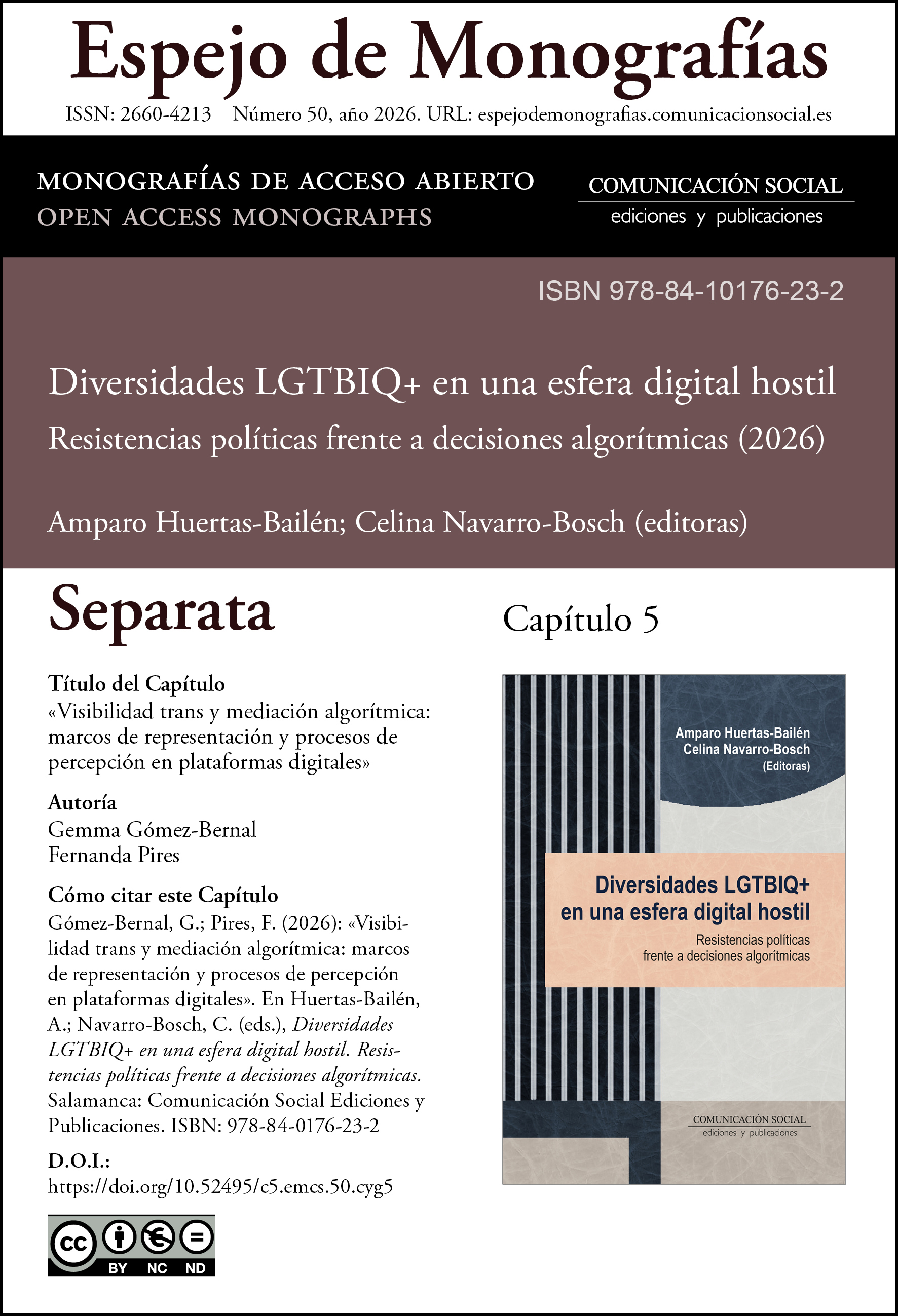
Capítulo 5. Visibilidad trans y mediación algorítmica: marcos de representación y procesos de percepción en plataformas digitales
DOI:
https://doi.org/10.52495/c5.emcs.50.cyg5Palabras clave:
algoritmos, plataformas digitales, personas trans, identidades de género, representación social, audienciasResumen
La visibilidad de las identidades trans en las plataformas digitales está mediada por sistemas algorítmicos que condicionan qué representaciones son posibles, legibles y circulables. Con este punto de partida, en este capítulo se analiza la visibilidad trans en Youtube, TikTok e Instagram desde una doble vertiente. Por un lado, tratamos de identificar y caracterizar los patrones de representación de la identidad trans privilegiados por los sistemas de recomendación y, por otro, los modos en que las audiencias interpretan dichos contenidos. Se empleó un diseño metodológico mixto sobre dos corpus diferenciados: uno estuvo compuesto por 3.000 publicaciones extraídas mediante herramientas específicas para cada plataforma, que fue analizado mediante codificación temática inductiva, y otro, por 10.125 comentarios de Youtube y TikTok, procesado mediante modelado de tópicos. Los resultados revelan cinco marcos de representación, de naturaleza colectiva e individual, cuya prevalencia varía según la arquitectura técnica y comercial de cada plataforma. Asimismo, se identifican cinco patrones de recepción que muestran una marcada divergencia entre plataformas. Mientras que TikTok concentra reacciones de reconocimiento estético y discusiones sobre la legitimidad corporal, Youtube alberga con mayor frecuencia posicionamientos hostiles, de corte político o religioso. Estos hallazgos evidencian que la visibilidad trans en los entornos digitales es constitutivamente paradójica y no garantiza reconocimiento social, sino que puede intensificar la exposición a la hostilidad. Todo ello subraya la necesidad de examinar críticamente la responsabilidad estructural de las plataformas en la producción de entornos digitales más justos y seguros para las comunidades trans.
Descargas
Referencias
Abidin, C. (2016). Visibility labour: Engaging with Influencers’ fashion brands and #OOTD advertorial campaigns on Instagram. Media International Australia, 161(1), 86 -100. https://doi.org/10.1177/1329878X1666517
Bettcher, T.M. (2014). Transphobia. TSQ: Transgender Studies Quarterly, 1(1-2), 249-251. https://doi.org/10.1215/23289252-2400181
Bhandari, A.; Bmo, S. (2022). Why’s everyone on TikTok now? The algorithmization of the For You Page. Social Media + Society, 8(1). https://doi.org/10.1177/20563051221086241
Billard, T.J. (2019). Setting the transgender agenda: Intermedia agenda-setting in the digital news environment. Politics, Groups, and Identities, 7(1), 165-176. https://doi.org/10.1080/21565503.2018.1532302
Blei, D.M.; Ng, A.Y.; Jordan, M.I. (2003). Latent dirichlet allocation. Journal of Machine Learning Research, 3, 993-1022.
boyd, d. (2026). Social Media Is Now Parasocial Media. Social Media+ Society, 12(2). https://doi.org/10.1177/20563051261437487
Braun, V.; Clarke, V. (2006). Using thematic analysis in psychology. Qualitative Research in Psychology, 3(2), 77-101. https://doi.org/10.1191/1478088706qp063oa
Brock, A. (2020). Disturbed blackness: African American cybercultures. NYU Press.
Bucher, T. (2018). If… then: Algorithmic power and politics. Oxford University Press.
Bucher, T.; Helmond, A. (2018). The affordances of social media platforms. In J. Burgess; A. Marwick; T. Poell (Eds.), The SAGE handbook of social media (pp. 233-253). SAGE https://doi.org/10.4135/9781473984066.n14
Büchi, M.; Fosch-Villaronga, E.; Lutz, C.; Tamò-Larrieux, A.; Velidi, S. (2023). Making sense of algorithmic profiling: user perceptions on Facebook. Information, Communication & Society, 26(4), 809-825. https://doi.org/10.1080/1369118X.2021.1989011
Burgess, J.; Green, J. (2018). Youtube: Online video and participatory culture. Polity Press.
Capuzza, J.C.; Spencer, L. G. (2017). Regressing, progressing, or transgressing on the small screen? Transgender characters on U.S. scripted television series. Communication Quarterly, 65(2), 214-230. https://doi.org/10.1080/01463373.2016.1221438
Cavalcante, A. (2017). Breaking Into Transgender Life: Transgender Audiences’ Experiences With ‘First of Its Kind’ Visibility in Popular Media.» Communication, Culture & Critique, 10, 538 -555. https://doi.org/10.1111/cccr.12165
Cavalcante, A. (2019). Tumbling into queer utopias and vortexes: Experiences of LGBTQ social media users on Tumblr. Journal of Homosexuality, 66(12), 1715-1735. https://doi.org/10.1080/00918369.2018.1511131
Chun, W.H.K (2021). Discriminating data: Correlation, neighborhoods, and the new politics of recognition. MIT Press.
Cinelli, M.; De Francisci Morales, G.; Galeazzi, A.; Quattrociocchi, W.; Starnini, M. (2021). The echo chamber effect on social media. Proceedings of the National Academy of Sciences, 118(9), e2023301118. https://doi.org/10.1073/pnas.2023301118
Cotter, K. (2019). Playing the visibility game: How digital influencers and algorithms negotiate influence on Instagram. New Media & Society, 21(4), 895 -913. https://doi.org/10.1177/1461444818815684
Davenport, T.H. & Beck, J.C. (2001). The attention economy: Understanding the new currency of business. Harvard Business School Press.
Dean, J. (2009). Democracy and other neoliberal fantasies: Communicative capitalism and left politics. Duke University Press.
Dean, J. (2010). Blog theory: Feedback and capture in the circuits of drive. Polity Press.
Duguay, S. (2016). Lesbian, gay, bisexual, trans, and queer visibility through selfies: Comparing platform mediators across Ruby Rose’s Instagram and Vine presence. Social Media + Society, 2(2). https://doi.org/10.1177/2056305116641975
Duguay, S. (2022). Personal but Not Private: Queer Women, Sexuality, and Identity Modulation on Digital Platforms. Oxford University Press.
Dyer, R. (1997). White. Routledge.
Eubanks, V. (2018). Automating inequality: How high-tech tools profile, police, and punish the poor. St. Martin’s Press.
Fink, M. & Miller, Q. (2014). Trans media moments: Tumblr, 2011-2013. Television & New Media, 15(7), 611-626. https://doi.org/10.1177/1527476413505002
Fraser, N. (2000). Rethinking recognition. New Left Review, 3, 107 -120.
Freelon, D. (2015). Discourse architecture, ideology, and democratic norms in online political discussion. New Media & Society, 17(5), 772 -791. https://doi.org/10.1177/1461444813513259
Frosh, P. (2019). The poetics of digital media. Polity Press.
Gillespie, T. (2014). The relevance of algorithms. In T. Gillespie; P.J. Boczkowski; K.A. Foot (Eds.), Media technologies: Essays on communication, materiality, and society (pp. 167-194). MIT Press.
Gillig, T.K.; Rosenthal, E.L.; Murphy, S.; Folb, K.L. (2018). More than a media moment: The influence of televised storylines on viewers’ attitudes toward transgender people and policies. Sex Roles, 78(7 -8), 515 -527. https://doi.org/10.1007/s11199-017-0816-1
Ging, D.; Siapera, E. (2019). Special issue on online misogyny. Feminist Media Studies, 18(4), 515-524. https://doi.org/10.1080/14680777.2018.1447345
Gossett, R.; Stanley, E.A.; Burton, J. (Eds.). (2017). Trap door: Trans cultural production and the politics of visibility. MIT Press.
Gray, M.L. (2009). Out in the country: Youth, media, and queer visibility in rural America. NYU Press
Habermas, J. (1991). The public sphere. En C. Mukerji; M. Schudson (Eds.), Rethinking popular culture: Contemporary perspectives in cultural studies (pp. 398-404). University of California Press.
Hall, S. (1980). Encoding/decoding. In S. Hall; D. Hobson; A. Lowe; P. Willis (Eds.), Culture, media, language (pp. 128-138). Hutchinson.
Helmond, A. (2015). The platformization of the web: Making data platform ready. Social Media + Society, 1(2), 1-11. https://doi.org/10.1177/2056305115603080
Herring, S.C. (2007). Questioning the generational divide: Technological exoticism and adult constructions of online youth identity. In D. Buckingham (Ed.), Youth, identity, and digital media (pp. 71-92). MIT Press.
Honneth, A. (1995). The struggle for recognition: The moral grammar of social conflicts. MIT Press
Hutchby, I. (2001). Technologies, texts and affordances. Sociology, 35(2), 441-456. https://doi.org/10.1177/S0038038501000219
Jenzen, O. (2017). Trans youth and social media: Moving between counterpublics and the wider web. Gender, Place & Culture, 24(11), 1626-1641. https://doi.org/10.1080/0966369X.2017.1396204
Jolley, D.; Paterson, J.L.; Deric, D.; Lovato, T.; McCarthy, J. (2024). Exploring how parasocial intergroup contact with transgender influencers on TikTok reduces transgender conspiracy beliefs. Journal of Community & Applied Social Psychology, 34(3), Artículo e2807. https://doi.org/10.1002/casp.70020
Maier, D.; Waldherr, A.; Miltner, P.; Wiedemann, G.; Niekler, A.; Keinert, A.; Pfetsch, B.; Heyer, G.; Reber, U.; Häussler, T.; Schmid-Petri, H.; Adam, S. (2018). Applying LDA topic modeling in communication research: Toward a valid and reliable methodology. Communication Methods and Measures, 12(2-3), 93 -118. https://doi.org/10.1080/19312458.2018.1430754
Marwick, A.E. (2015). Instafame: Luxury selfies in the attention economy. Public Culture, 27(1), 137-160. https://doi.org/10.1215/08992363-2798379
Massanari, A. (2017). #Gamergate and the Fappening: How Reddit’s algorithm, governance, and culture support toxic technocultures. New Media & Society, 19(3), 329-346. https://doi.org/10.1177/1461444815608807
Masanet, M.J.; Ventura, R.; Ballesté, E. (2022). Beyond the ‘Trans Fact’? Trans Representation in the Teen Series Euphoria: Complexity, Recognition, and Comfort. Social Inclusion, 10(2), 143-155. https://doi.org/10.17645/si.v10i2.4926
Noble, S.U. (2018). Algorithms of oppression: How search engines reinforce racism. NYU Press.
Pariser, E. (2011). The filter bubble: What the internet is hiding from you. Penguin Press.
Papacharissi, Z. (2002). The virtual sphere: The internet as a public sphere. New Media & Society, 4(1), 9-27. https://doi.org/10.1177/14614440222226244
Papacharissi, Z. (2015). Affective publics: Sentiment, technology, and politics. Oxford University Press.
Pires, F.; Revelles-Benavente, B. (2020). Co-viewing a lesbian kiss between two elderly characters: Unveiling axes of oppression through the Brazilian telenovela Babilônia. Poetics, 80, 101430. https://doi.org/10.1016/j.poetic.2019.101430
Pullen, C. (Ed.). (2012). LGBT transnational identity and the media. Palgrave Macmillan.
Raun, T. (2016). Out online: Trans self-representation and community building on YouTube. Routledge.
Rieder, B. (2015) Introducing the YouTube data tools. In: The Politics of Systems. Thoughts on Software, Power, and Digital Method. Available at: http://thepoliticsofsystems.net/2015/05/exploring-youtube/
Schiappa, E.; Gregg, P. B.; Hewes, D. E. (2006). Can one TV show make a difference? Will & Grace and the parasocial contact hypothesis. Journal of Homosexuality, 51(4), 15 -37. https://doi.org/10.1300/J082v51n04_02
Spade, D. (2011). Normal life: Administrative violence, critical trans politics, and the limits of law. South End Press.
Srauy, S. (2019). Professional norms and race in the North American video game industry. Games and Culture, 14(5), 478-497. https://doi.org/10.1177/1555412017708936
Striphas, T. (2015). Algorithmic culture. European Journal of Cultural Studies, 18(4 -5), 395-412. https://doi.org/10.1177/1367549415577392
Tiidenberg, K.; van der Nagel, E. (2020). Sex and social media. Emerald Publishing.
Tufekci, Z. (2018, March 10). YouTube, the great radicalizer. The New York Times. https://www.nytimes.com/2018/03/10/opinion/sunday/youtube-politics-radical.html
van Dijck, J.; Poell, T.; De Waal, M. (2018). The platform society: Public values in a connective world. Oxford University Press
YouTube. (2025). How YouTube’s recommendation system works. Google Support. https://support.google.com/youtube/answer/16089387
Warner, M. (2002). Publics and counterpublics. Zone Books
Zaparanuks, D.; Hauswirth, M. (2012, June). Algorithmic profiling. In Proceedings of the 33rd ACM SIGPLAN conference on Programming Language Design and Implementation (pp. 67-76). https://doi.org/10.1145/2254064.2254074
Zappavigna, M. (2012). Discourse of Twitter and social media: How we use language to create affiliation on the web. Continuum.
Publicado
Número
Sección
Licencia

Esta obra está bajo una licencia internacional Creative Commons Atribución-NoComercial 4.0.
Los artículos publicados en la revista se distribuyen con la Licencia Creative Commons Atribución-NoComercial-SinDerivadas 4.0 Internacional